Cheetahs have been extirpated from 91% of their range, and they could soon go extinct, unless you do something.
Add your name if you want to protect all cheetahs from trophy hunters, NOW!
"Cheetahs have vanished from approximately 90 percent of their historic range in Africa, and are extinct in Asia except for a single, isolated population of perhaps 50 individuals in central Iran," reported WildLifeDay.org.
And the bad news doesn't stop there. According to the same source:
"79% of all cheetah populations contain 100 or fewer individuals."
This means that every single time a cheetah is killed, there is a chance that another small, local population will disappear forever.
The same organization estimates the current worldwide wild cheetah population at approximately 7100 individuals.
Only 7100 cheetahs remain. Let that sink in.
I know you can see how cheetahs could soon be gone forever, if this horrifying trend continues.
How do we save them?
"The low density of cheetahs throughout their range means they require conservation action on a scale that is seldom seen in terrestrial conservation.
"This includes transboundary cooperation, land use planning across large landscapes to maintain habitat connectivity, and human wildlife conflict mitigation," according to the source referenced above.
It's going to take BIG, international efforts for this to work.
That's why we're calling on the Pan African Parliament, as well as the Asian Parliamentary Assembly, to work together and do whatever it takes to ban trophy hunting of cheetahs across their entire range.
Don't you want to stop this cruel, heartless practice of murdering rare cheetahs for fun?
Then add your name to join in the two-pronged effort to save cheetahs, before it's too late.
First, we're going to ask Malik Hussein, Chairperson of the Committee on Rural Economy Agriculture, Natural Resources and Environment for the Pan African Parliament, to introduce a motion to protect cheetahs from trophy hunting all across the African continent!
Second, we're going to ask the Asian Parliamentary Assembly to do the same, working in coordination with African nations, to ensure that the global populations is well protected.
Today, yoga continues to increase in popularity throughout the world. People might have many doubts that keep them wondering if it’s worth signing up for a yoga teaching training in Rishikesh, India – are they good enough? Can they sign up as a yoga teacher even if they don’t have a lot of experience? Will they be able to teach right after? How much time do they have to spend on it?
These are all valid questions that can influence your decision to become a yoga teacher. This article will help you out with all these questions! Normally you should have some sort of experience before you start as a yoga teacher. But this doesn’t mean you have to be an expert, it means you should be comfortable with basic yoga “asanas”.
Here are 10 things you should know before you embark on yoga teacher training:
1. Let out expectations
No one can tell you what will happen, and no one can tell you how you will feel. When choosing to begin, remember that all you can do is your best. Just let go of what happens at the end – instead, enjoy the journey.
2. Set your goal
Just as you set goals at the beginning of your class, set some goals for your teacher training – but always remember why you practice yoga and why you want to teach it. This solid foundation is useful to come back to if things get a little overwhelming or tough at times.
You may begin a yoga course with an intention to become a yoga trainer. Afterwards, but halfway through you find that actually it is not appealing as it seems first. Alternatively, you may feel like you have no courage to stand up at the front of class and teach- but this can change too!
3. DIY (Do it for yourself)
Practice and learn for yourself; whether you are ready to teach afterwards or not, you must be able to share your love of yoga from an authentic and pure place within you.
4. Don’t be embarrassed over what you don’t know
It will take some time for you to learn or understand some words, subjects and postures. This is nothing to worry about. Treat it as an exploration, be curious, make mistakes, become confused and ask for help without embarrassment.
5. Stock up on tissues
There is a lot of crying! Whether they are your tears or someone else’s this will often be a big part of your teaching training. As we know self- development is a huge thing; it is very important to let go of your baggage before standing up in front of a group of people and telling them to let go of theirs.
Unexpected emotions, tiredness, discomfort and even a sense of being overwhelmed are fully normal when you are choosing to study in-depth. When you find comfort in this discomfort than you are on a journey of growth and self-discovery..
6. Look after yourself
This course is very much a mixture of physical practice and plenty of sittings and postures. Be mindful and kind while bringing your body from sitting position to yoga posture. When training, injuries may occur if you are not comfortable in certain postures. You have to just listen to your body. Always remember that you are just at the beginning: the best trainers or teachers are the ones who have had to learn from themselves first and can pass on this wisdom to others.
7. Learn and study well
Study carefully when it comes to the injury risks of yoga and learn about the mishaps that have happened in modern yoga classes. Students may blame a teacher for their injury due to poor knowledge or lack of communication. When you are training someone how to move their body and how to breathe, it’s essential that you know what you are doing.
8. It’s just like a bumpy ride
At some point you will feel on top of the world; you love yoga like nothing else and you can’t wait to learn more. The next moment, you will feel that you never want to see another yoga mat. It’s OK. Let this happen and take some breaks.
When you feel like you can’t possibly absorb any more information, take a break from your yoga practice and do something completely different. Go for a walk, enjoy time with friends, spend time cooking or whatever else relaxes and de-stresses you.
9. Confronting different personalities
Undergoing long hours of intense growth and learning with the same group of people can be a valuable lesson. As a yoga teacher, it is important to understand that everyone is different. And they have their own set of rules and priorities. Some people’s egos can be difficult to deal with.
Learning about Ayurveda and doshas can be a huge help in recognising other people’s actions.
10. Always remember, this is just the beginning
It is not about throwing shapes, drinking coconut water, or simply showing up and then taking the rest of the day off to shop for some new yoga pants… sorry!
You should focus on your intention, teach from your heart, share what you know and continue to grow.
The essential parts of teaching yoga are both self-reflection (Svadhyaya) and study; when you graduate from your first yoga teacher training course, you’ll likely realise that this is only the beginning of a lifelong journey. There’s no limit to where yoga could take you, and it’s all about practice and learning.
Salk researchers discovered a set of neurons in the spinal cord that help transmit a light-touch signal from the skin to the brain
Light touch plays a critical role in everyday tasks, such as picking up a glass or playing a musical instrument. The sensation is also an essential part of the body’s protective defense system, alerting us to objects in our environment that could cause us to fall or injure ourselves. In addition, it is part of the detection system that has evolved to protect us from biting insects, such as those that cause malaria and Lyme disease, by eliciting a feeling of an itch when an insect lands on your skin.
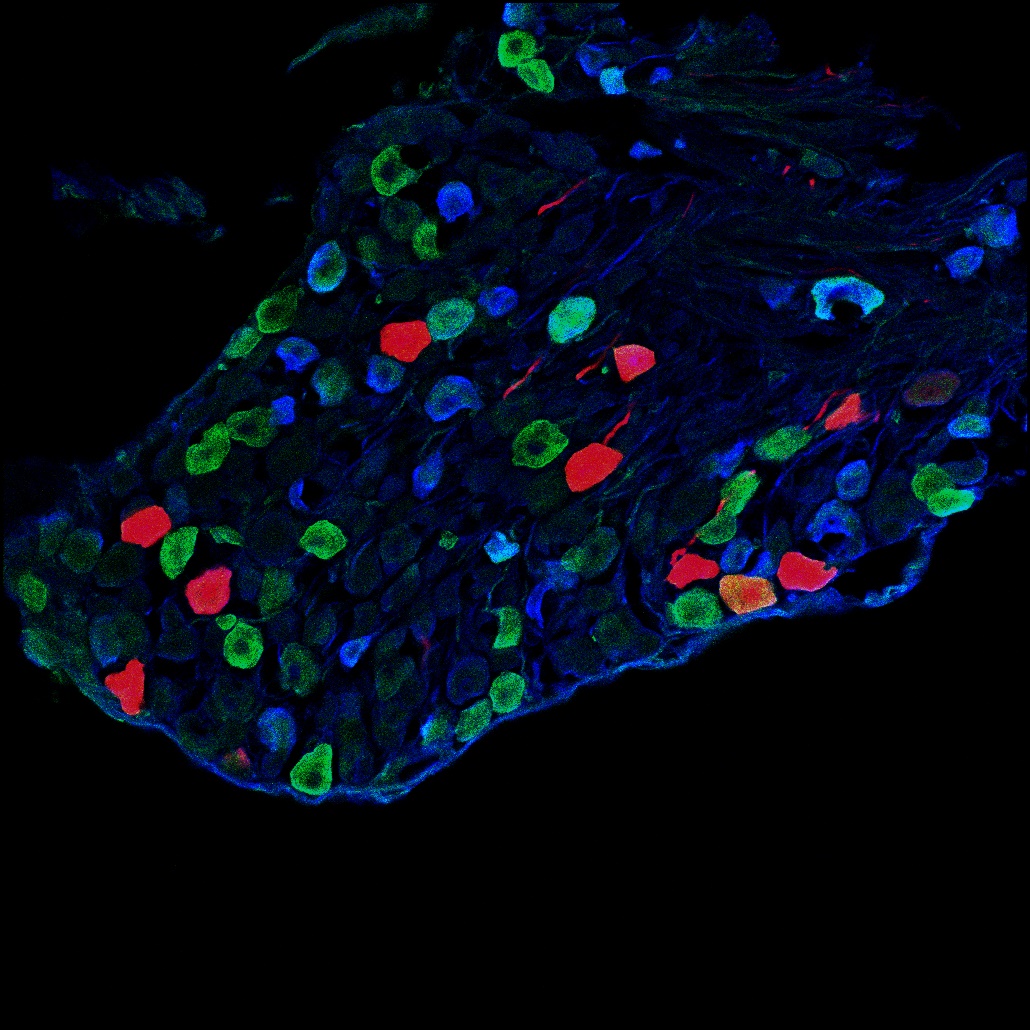
A cross-section from a dorsal root ganglion showing sensory neurons that transmit light-touch information from the skin to Y1 neurons within the spinal cord. Credit: Salk Institute
Salk researchers have discovered how neurons in the spinal cord help transmit such itch signals to the brain. Published in the journal Cell Reports on July 16, 2019, their findings help contribute to a better understanding of itch and could lead to new drugs to treat chronic itch, which occurs in such conditions as eczema, diabetes and even some cancers.
“The takeaway is that this mechanical itch sensation is distinct from other forms of touch and it has this specialized pathway within the spinal cord,” says Salk Professor Martyn Goulding, holder of the Frederick W. and Joanna J. Mitchell Chair and a senior author of the new work.
Goulding and his colleagues had previously discovered a set of inhibitory neurons in the spinal cord that act like cellular brakes, keeping the mechanical itch pathway in the spinal cord turned off most of the time. Without these neurons, which produce the neurotransmitter neuropeptide Y (NPY), the mechanical itch pathway is constantly on, causing chronic itch. What the researchers didn’t know was how the itch signal, which under normal circumstances is suppressed by the NPY neurons, is transmitted to the brain to register the itch sensation.
David Acton, a postdoctoral fellow in the Goulding lab, hypothesized that when the NPY inhibitory neurons are missing, neurons in the spinal cord that normally transmit light touch begin to act like an accelerator stuck in the “on” position. Acton then identified a candidate for these “light touch neurons,” a population of excitatory neurons in the spinal cord that express the receptor for NPY, the so-called Y1 spinal neurons.
From left: Martyn Goulding and David Acton Credit: Salk Institute
To test whether these neurons were indeed acting like an accelerator, Acton undertook an experiment that involved selectively getting rid of both the NPY “brake” and Y1 “accelerator” neurons. Without Y1 neurons, mice didn’t scratch, even in response to light-touch stimuli that normally make them scratch. Moreover, when Acton gave the animals drugs that activated the Y1 neurons, the mice scratched spontaneously even in the absence of any touch stimuli. The Goulding team was then able to show that the NPY neurotransmitter controls the level of Y1 neuron excitability; in other words, NPY signaling acts as a kind of thermostat to control our sensitivity to light touch. Data from other labs has found that some people with psoriasis have lower than average levels of NPY. This may mean their brakes on mechanical itching are less effective than other people’s, a potential cause of their itching.
While Y1 neurons transmit the itch signal in the spinal cord, other neurons are thought to be responsible for mediating the final response in the brain but more research is needed to continue mapping out the full pathway, according to the researchers. Understanding this will help suggest targets for drugs to turn down the sensation of itch in people who are overly responsive and could lead to ways to address chronic itch.
“By working out mechanisms by which mechanical itch is signaled under normal circumstances, we might then be able to address what happens in chronic itch,” says Acton.
Other researchers on the study were Xiangyu Ren, Stefania Di Costanzo, Antoine Dalet and Steeve Bourane of the Salk Institute; and Ilaria Bertocchi and Carola Eva of the University of Torino.
The study was supported by the National Institutes of Health and the Caterina Foundation.
Today a beautifully delicious dish, Crispy Sheet Pan Chicken Milanese, perfectly sized for just two people!
I love chicken recipes like this. Recipes that are simple to make, with no fuss or muss, but that give excellent delicious results. With this one you get lovely tender, crisp golden crumb and cheese chicken breasts, flavoured with garlic and lemon.
They are baked rather than fried, which makes them a bit healthier. You also have crisp golden brown potatoes . . . again flavoured with butter and garlic . . . if you are low carbing it, you could replace them with cauliflower florets.
Add to the mix, beautiful crispy tender green beans, again flavoured with butter and garlic . . .
The coated chicken and potatoes are roasted first and then you add the green beans and roast them for a bit longer . . .
By then your potatoes will be getting crisp and golden brown also . . . finally you add some halved baby plum tomatoes, which you drizzle with a bit of Balsamic vinegar, to help bring out their natural sweetness, and pop everything back into the oven just until the tomatoes are wilted and beginning to caramelise . . .
This is such a beautiful combination . . . tender juicy crisp coated chicken, crispy buttery potatoes, crispy tender green beans, caramelised tomatoes . . .
You can’t go wrong!
Dust the tray with some additional finely grated Parmesan cheese . . . .
Sprinkle with some parsley to give an additional colour hit . . .
Pass out the lemon wedges for squeezing . . . or not as you desire.
Myself, I enjoy a hit of lemon . . .
Altogether a beautiful dish, delicious and colourful, generously sized with nothing to wash up except for your eating utensils. You can’t go wrong!
Spring isn’t the only season that can bring dreaded colds and sinus problems. For many people, fall allergies can be just as much of a concern.
Spring isn’t the only season that can bring dreaded allergies. For many people, fall, with its ragweed pollen and mold spores, accompanies fits of sneezing, coughing, runny noses, and watery eyes.
To combat fall allergies, you can try herbal remedies. In particular, here are 11 excellent sources of natural relief:
1. Elderberry
Elderberry tones the respiratory tract and keeps the airways clear from phlegm. Moreover, research confirms that elderberries contain compounds which strengthen the immune system and help ward off infections.
2. Sarsaparilla
Sarsaparilla is a rich source of flavonoids. Flavonoids in sarsaparilla have proven to be effective in reducing inflammation caused by fall allergies, asthma, and bronchitis.
3. Horseradish Root
This root vegetable relieves coughs and bronchitis, it also soothes inflamed tissues. Horseradish root opens clogged sinuses and further facilitates their drainage. Our sinus cavities often have poor circulation of blood. Horseradish root improves the circulation of the whole body. As a result, immune compounds from the blood reach the sinuses more efficiently to fight infection.
4. Echinacea
Echinacea is well-known for its tonic effect on the immune system. While some people use it as a preventative herb, I prefer to use it for acute, short-term use.
5. Spilanthes
Spilanthes possesses immune-supporting compounds which help ward off infection. Additionally, it has a tingling, numbing effect, which makes it useful for relieving the discomfort of a sore throat.
6. Garlic
Garlic lessens the symptoms of fall allergies. Symptoms including, runny noses, fevers, coughing, sinus congestion, bronchitis, and shortness of breath. Furthermore, its immune and circulatory-enhancing effects aid the body’s immune system and relieve infections.
7. Horehound
This plant has been used since antiquity and is a superb remedy for sore throats. Most notably, horehound enhances immune health. The herb is useful for treating upper and lower respiratory tract illnesses. Horehound possesses decongestant properties which hasten healing.
8. Licorice Root
Licorice root combines well with other herbs used to relieve respiratory problems. In fact, it strengthens the actions of other herbs. Licorice has been employed for centuries to support respiratory health. Furthermore, modern science confirms that licorice enhances immune health. Licorice works as a decongestant, clearing mucus and hastening healing. Also, its sweet flavor helps make less tasty herbs more palatable.
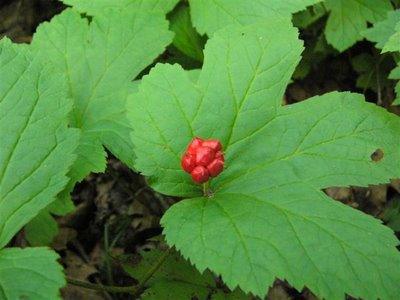
Goldenseal root is a perennial herb that many people use to treat minor respiratory issues.
9. Goldenseal Root
Goldenseal root is a perennial herb that many people use to treat minor respiratory issues. It is an at-risk plant, so I prefer to use goldenseal only for serious infections. Overall, the most active compound in goldenseal is called berberine. Berberine is also found in Oregon grape root and barberry root. However, for minor ills, I prefer to use these herbs as alternatives to goldenseal. If you opt to use goldenseal, purchase organically cultivated roots only.
10. Yerba Mate
This particular herb contains compounds which open up air passages. Therefore, it is useful for the treatment of allergies, asthma, and other respiratory illnesses.
11.Andrographis
Specifically, Andrographis prevents and treats the common cold, influenza, bronchitis, tonsillitis, allergies, pneumonia, and sinusitis. It is a powerful herb which has been the subject of several studies that confirm its healing benefits for the respiratory system.
Using Herbs To Relieve Fall Allergies, Colds, And Sinus Congestion
Herbs are available in many forms, including capsules, tablets, tinctures, and in bulk.
However, I usually prefer to use herb teas to relieve upper respiratory ills. The warm beverages help to unclog sinuses and soothe sore throats.
In essence, tinctures are convenient. Herbs in tincture form are readily absorbed. However, alcohol-based tinctures often extract plant compounds that teas cannot.
Try making a gargle with herbs. Gargles are surprisingly excellent tools for preventing illness and alleviating symptoms if illness occurs. On the whole, they help to relieve sinus congestion and post-nasal drip.
Surprisingly, one of the most effective methods of herb administration is to make an herbal steam. Simply place a few spoonfuls of a bulk herb in a pot over steaming hot water. Next, sit facing the pot with a towel draped over your head. Eucalyptus, thyme, oregano, and rosemary make good antibacterial steams.
Surprisingly, herbs are among the most effective tools available for preventing and treating fall allergies. Unlike pharmaceuticals, most herbs are well-tolerated with no or few side effects. If you have a serious respiratory illness or long-standing health problems, first consult with your health care provider.
You may also enjoy reading an additional Off The Grid News article:
For many people, lower back pain is one of those lingering annoyances that just always seems to find its way back, for lack of a better word. If you are one of the millions of people who live with chronic lower back pain, a new study conducted at the University of Michigan may be of interest to you. Researchers say that self-administered acupressure, a traditional Chinese medicine technique, can help improve the nagging condition and reduce the brutal pain that comes with it.
Acupressure is often confused with with acupuncture, but needle-haters needn’t worry; acupressure doesn’t involve being pricked. “Acupressure is similar to acupuncture, but instead of needles, pressure is applied with a finger, thumb or device to specific points on the body,” explains lead author Susan Murphy, ScD, OTR, in a statement.
Previous research had already found acupressure to be helpful in the treatment of cancer-related pain or osteoarthritis pain, but its effect on back pain had not been properly investigated. So, the research team randomly assigned 67 participants dealing with chronic lower back pain into three groups: usual care, relaxing acupressure, and stimulating acupressure.
Traditionally, relaxing acupressure is used to treat insomnia, while stimulating acupressure is more commonly used in fatigue reduction.
Participants in both acupressure groups were taught how to perform the technique on themselves, and spent about a half hour each day self-administering for a total of six weeks. Meanwhile, participants in the usual care group simply went about their usual lower back treatments for six weeks.
“Compared to the usual care group, we found that people who performed stimulating acupressure experienced pain and fatigue improvement and those that performed relaxing acupressure felt their pain had improved after six weeks,” Murphy says. “We found no differences among the groups in terms of sleep quality or disability after the six weeks.”
Murphy and her team say that chronic pain is a difficult condition to live with, that often leads to more problems such as depression and problems sleeping. Additionally, most modern treatments for chronic pain are medications that usually include side effects and the potential for abuse or addiction.
This study, however, illustrates that there are still all natural, non-pharmacological solutions to chronic lower back pain that patients can perform independently. Researchers admit that additional research is still needed, but they believe acupressure can be a useful, low cost, and low risk pain management tool.
Moving forward, Murphy would like to perform studies on the different types of acupressure, in order to determine if different techniques alleviate different pain symptoms or body areas.
The study is published in the scientific journal Pain Management.